 Comfortable ClassicsComfortable Classics
Why is a long journey called an odyssey? What is an Achilles' heel, a Pandora's box, or a narcissist? The answers are in the myths of ancient Greece and Rome, and for generations of readers the doorway to those stories has been Bulfinch's Mythology.
Thomas Bulfinch was a Boston bank clerk and lifelong scholar who believed that everyone, not just students of Latin and Greek, should know the old stories. Literature, art, and everyday language were full of references to gods and heroes, and he wanted ordinary readers to understand them. In 1855 he published The Age of Fable, or Stories of Gods and Heroes, retelling the classical myths in clear, graceful prose "for the reader of English literature." It became one of the best-loved mythology books in America.
Here are the gods of Olympus: mighty Jupiter, jealous Juno, wise Minerva, and radiant Apollo. Here is Prometheus stealing fire for humankind, and Pandora opening the box that let sorrow into the world. Here are the great love stories of Cupid and Psyche, Pyramus and Thisbe, and Orpheus descending into the underworld for Eurydice. Here are the heroes: Perseus and Medusa, Theseus and the Minotaur, Hercules and his labors, Jason and the Golden Fleece. Bulfinch also retells the Trojan War and the wanderings of Ulysses and Aeneas, and goes beyond Greece and Rome to the myths of the Norse gods and other ancient peoples.
Bulfinch often weaves in lines from poets such as Milton, Shakespeare, Byron, and Tennyson, which show how these myths echo through centuries of English literature. His book is not only a storybook but a key to the art, poetry, and language of Western culture. Bulfinch uses the Roman names for most of the gods, so Zeus appears as Jupiter and Athena as Minerva, as was common in his day.
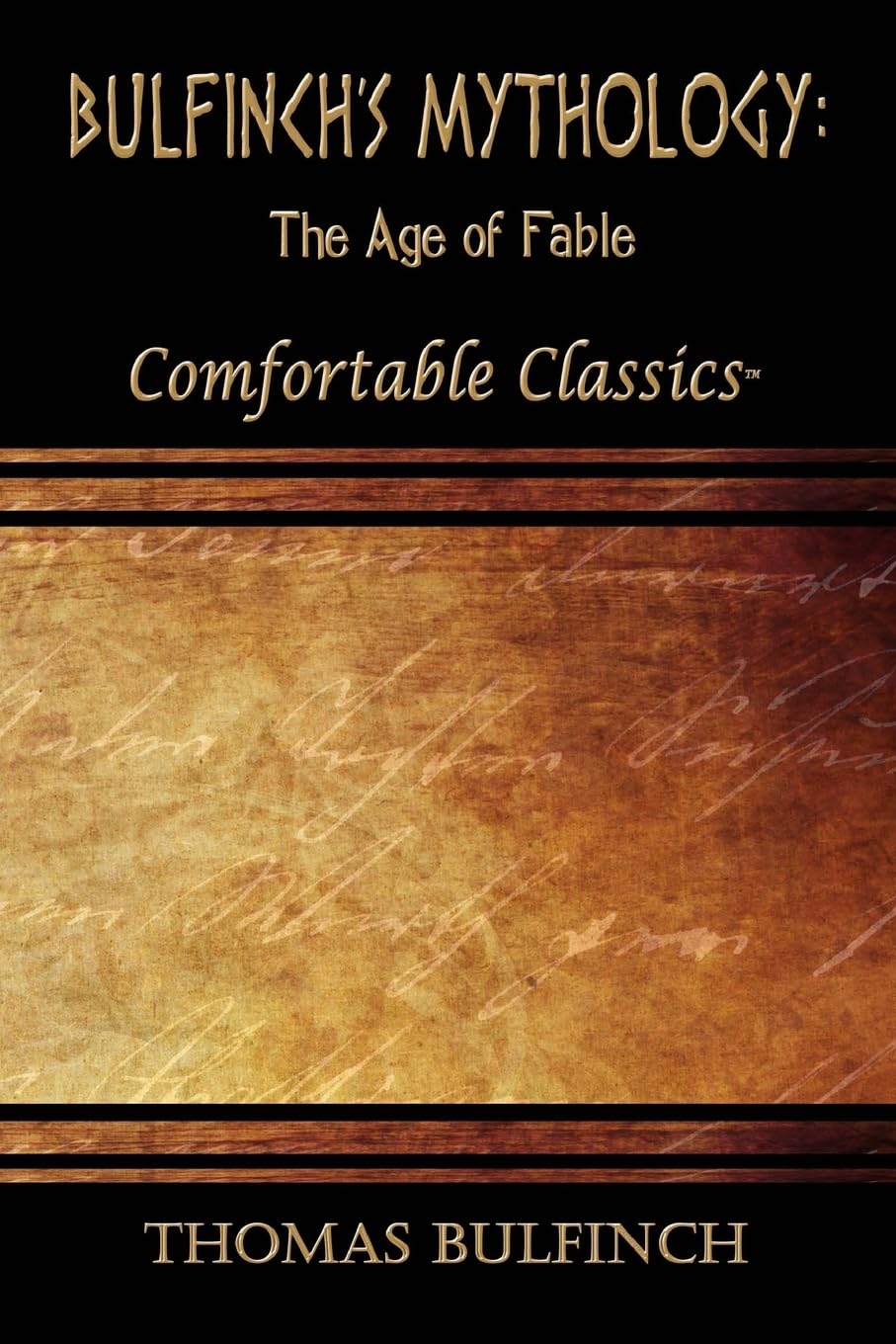
Comfortable Classics was created to help families build a library worth keeping. Each book in the series shares the same handsome design, a black cover with warm wood-grain bands and a parchment panel. Only the title lettering changes, chosen to suit each book's spirit. Together they make a matching collection that looks beautiful on a shelf and invites you to take the next one down.
Classics meant to be kept, studied, and handed down.
These myths were passed from parent to child for thousands of years before Bulfinch wrote them down. Keep the tradition going with a tale a night.
Part of the Comfortable Classics series. Collect the matching set.