 Comfortable ClassicsComfortable Classics
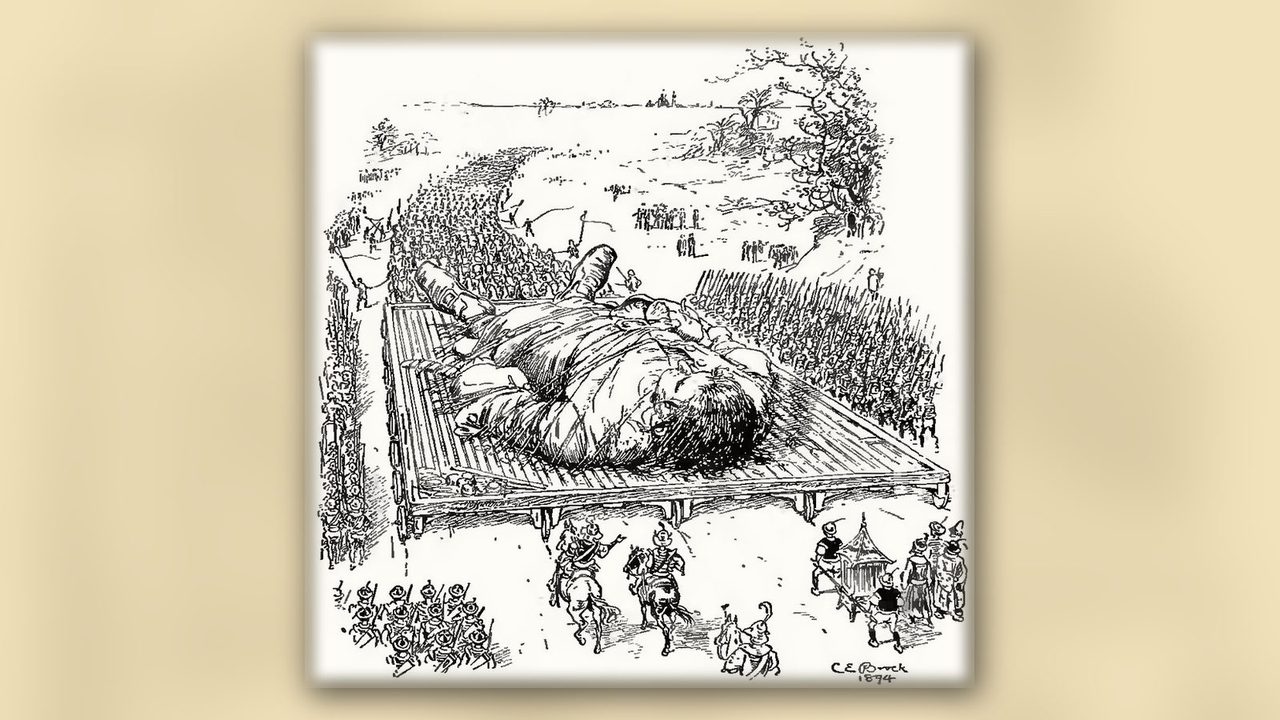
A shipwrecked sailor wakes on a beach to find himself tied to the ground with hundreds of tiny threads, while an army of people no bigger than his finger swarms over his chest. It is one of the most famous scenes in literature. Published in 1726, Jonathan Swift's Gulliver's Travels is at once a delightful fantasy adventure and one of the sharpest satires ever written.
Lemuel Gulliver is a ship's surgeon with a restless spirit, and his voyages carry him to four astonishing lands. In Lilliput, he is a giant among six-inch-tall people whose emperor is at war with a neighboring nation over which end of an egg should be cracked first. In Brobdingnag, the tables are turned: Gulliver is the size of a toy among giants, kept as a pet by a farmer's daughter and questioned by a wise king who is horrified by his descriptions of English politics and warfare. On the flying island of Laputa, he meets scholars so lost in abstract theories that they need servants to flap them on the head to remind them to speak or listen, and he visits an academy dreaming up absurd projects like extracting sunbeams from cucumbers. Finally, in the land of the Houyhnhnms, he encounters noble, reasoning horses who rule over brutish human-like creatures called Yahoos, and Gulliver begins to see his own kind in an unsettling new light.
Swift was an Anglo-Irish clergyman, Dean of St. Patrick's Cathedral in Dublin, and the greatest satirist of his age. He wrote the book, he said, "to vex the world rather than divert it." Beneath its fantastic adventures lie biting criticisms of politics, science, pride, war, and human nature. Children have loved the first two voyages for generations for their sheer imagination, while adults find more to discover with every reading.
Gulliver's Travels gave the English language words such as "Lilliputian" and "Yahoo," and it has been adapted countless times for film, television, and the stage.
Comfortable Classics was created to help families build a library worth keeping. Each book in the series shares the same handsome design, a black cover with warm wood-grain bands and a parchment panel. Only the title lettering changes, chosen to suit each book's spirit. Together they make a matching collection that looks beautiful on a shelf and invites you to take the next one down.
Classics meant to be kept, studied, and handed down.
Gulliver comes home from every voyage seeing his own world differently. Share it with a young reader for Lilliput, then revisit it together years later for its satire.
Part of the Comfortable Classics series. Collect the matching set.