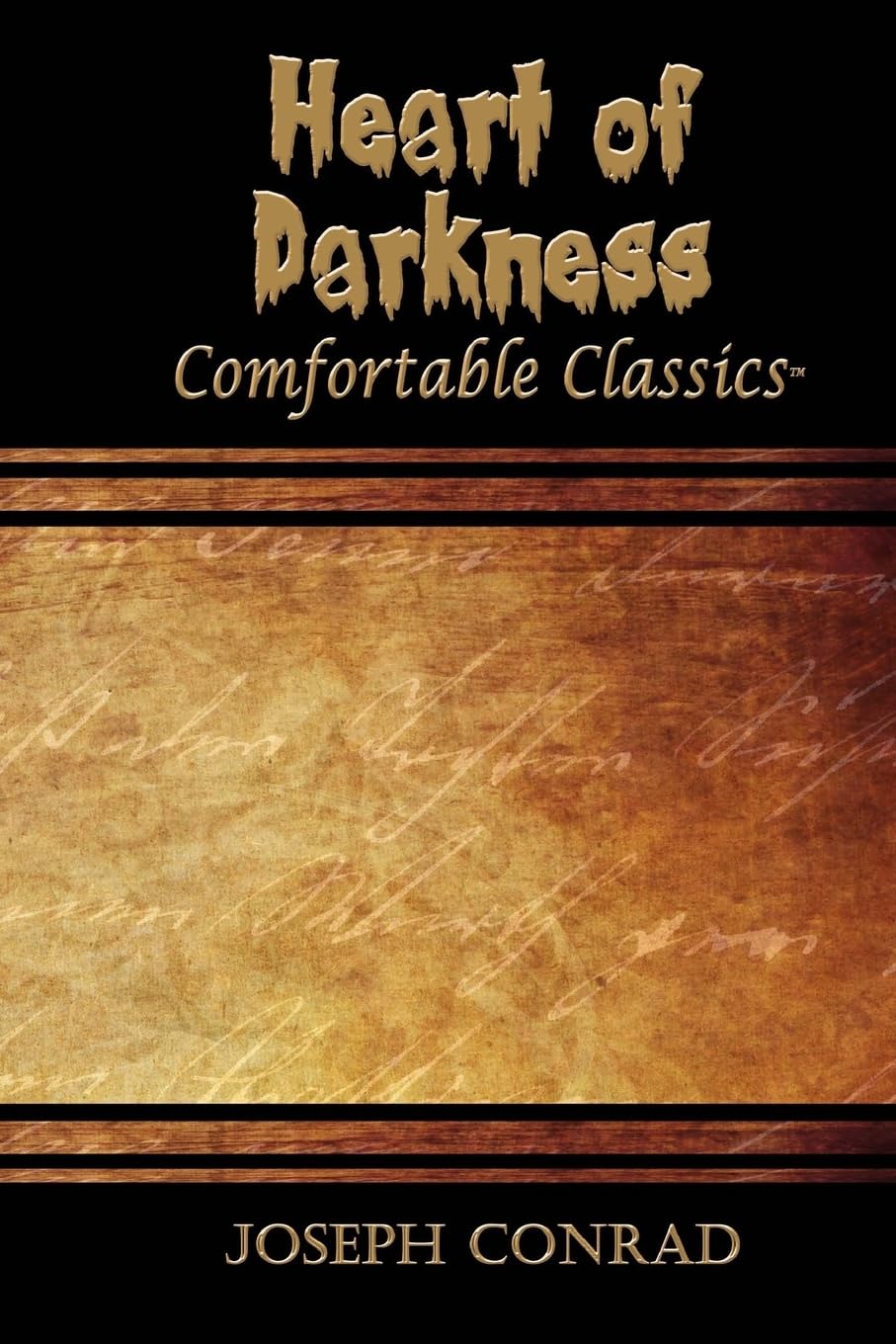
 Comfortable ClassicsComfortable Classics

First published in 1899, Heart of Darkness is one of the most powerful and most debated short novels in the English language. In barely a hundred pages, Joseph Conrad takes readers on a journey up a great African river and into the darkest corners of the human heart.
The story opens at dusk on a boat anchored in the Thames, where a sailor named Marlow begins to tell his companions about a voyage from his past. As a young man, he took a job with a Belgian trading company and sailed into the Congo to captain a river steamer. Along the way he hears rumors of Kurtz, the company's most celebrated agent: a gifted, eloquent man stationed deep in the interior, said to send back more ivory than all the others combined. The farther upriver Marlow travels, the more Kurtz becomes an obsession and a mystery. When the two finally meet, Marlow discovers what can happen to a person cut off from every rule, every witness, and every restraint.
Conrad drew on his own 1890 journey up the Congo River, and the book is shaped by what he saw firsthand of the brutal colonial ivory trade. His writing is dense, atmospheric, and haunting. The jungle presses in, the river winds into silence, and every scene seems wrapped in fog and shadow. Marlow's telling is layered and uncertain, so readers are left to weigh for themselves what is truth, what is illusion, and what the "darkness" of the title really means.
Over more than a century, Heart of Darkness has inspired writers, filmmakers, and thinkers, most famously the film Apocalypse Now. It has also sparked important criticism, especially Chinua Achebe's influential argument that the novel portrays Africans without voice or humanity. That ongoing conversation is part of what makes the book so valuable to read and discuss today.
Comfortable Classics was created to help families build a library worth keeping. Each book in the series shares the same handsome design, a black cover with warm wood-grain bands and a parchment panel. Only the title lettering changes, chosen to suit each book's spirit. Together they make a matching collection that looks beautiful on a shelf and invites you to take the next one down.
Classics meant to be kept, studied, and handed down.
A short novel that challenges each generation that reads it. Study it with a high school or college student, alongside its critics.
Part of the Comfortable Classics series. Collect the matching set.